N V SATYANARAYANA

Showing posts with label world news. Show all posts

Tuesday, December 6, 2011

Facebook Timeline Rollout Starts Today, First In New Zealand


screen-shot-2011-09-22-at-11-00-09-am

Facebook has announced that it will begin rollout of Timeline, starting with New Zealand. If successful there it will release the profile redesign elsewhere. The country was likely picked because it speaks English, which eases feedback processing, and isn’t as interconnected with the rest of the user base as some other countries. It’s been 2.5 months since Facebook unveiled the Timeline profile redesign at f8 and said the rollout would begin shortly. However, possibly due to product tweaks and a lawsuit from Timelines.com, until today the feature was only available to developers, or those who pose as them.

Facebook will have to explain the privacy ramifications of Timeline very carefully. By making the entire history of a user’s Facebook activity more readily accessible, embarrassing or objectionable content could be surfaced if users don’t know to curate their Timelines properly.

Facebook posted this statement about the New Zealand rollout to the original blog post announcing Timeline:

“We announced Timeline in September and made it available to developers building apps on our platform. Since then, over a million people have signed up for the developer beta to access Timeline. The feedback we’ve received so far has been invaluable. Starting today, we are making Timeline more widely available as we measure speed and other types of performance. We’ll begin by making it available to people in New Zealand and then roll it out more broadly in the near future.”

The Timeline profile design allows users and their friends much easier access to their historical content, such as status updates or wall posts they made years ago. This means Facebook’s servers will have to be able to quickly serve up content that was rarely accessed in the past. To make sure the entire user base isn’t impacted by performance issues, it has chosen to roll out the redesign in a relatively small and isolated area first. If Facebook’s infrastructure can support the New Zealand rollout without slowing down the site or causing privacy hysteria, it will then continue the rollout.

Facebook may have used New Zealand as a test bed before, as we received reports of an iteration of the Questions product appearing there before other countries. Because the island country is less interconnected with the rest of the world, it can be easier to keep tests there a secret. In other cases, Facebook tests products in the US first where early adopters are plentiful and market penetration, social graph density, and smartphone use is high. This lets the company test products the way they’re meant to be used — with everyone you know using them too.

[Update: A Facebook spokesperson confirmed with me that New Zealand users will have a 7 day review period, during which their Timeline is only visible to them and their friends will see their profile as before. Users can opt to publish their Timeline and replace their old profile with it during the review period, but the Timeline will automatically publish after 7 days.]

With the rollout will come a bonanza for developers of apps that leverage the Open Graph API that can publish content to the Timeline. Developers who’ve been prepping their apps in anticipation of the universal access to Timeline should start putting the finishing touches on so they’re ready when the rollout expands.

Most importantly, though, will be how Facebook handles messaging around privacy with Timeline. Combing through years of content can be quite a chore. If Facebook doesn’t explain how crucial this is, users may inadvertently make it easier for parents and bosses to find racy photos and objectionable jokes. Horror stories about lost jobs or offended families could scare users away from using the Open Graph apps that publish to Timeline which Facebook is betting will help it follow Zuckerberg’s Law of doubling the volume of content we share each year.

After The Regretsy and Diaspora Account Freezes, We’ve Lost Confidence In PayPal


PayPal Freezes Accounts

Hey PayPal, do you realize people no longer trust you? By heartlessly freezing the accounts of legitimate causes, you’ve shaken our confidence. By releasing the funds only in response to public pressure, you’ve shown that your policy enforcement is erratic and our money can disappear on a whim. The account freezes have become such fiascoes that they transcend the facts. Even if you’re boxed in by the law, even if these companies accidentally misused your product, it doesn’t matter. The public’s perception is that there’s a risk in keeping money with PayPal. If something doesn’t change, startups, causes, and merchants will start processing donations and payments elsewhere.

Today’s blunder where you froze the account ofRegretsy as it tried to buy toys for poor kids is going to stick in people’s minds for a long time. It follows you freezing accounts of open source social network Diaspora, Minecraft creator Markus Persson, and social network for models Zivity. I won’t even get into your controversial stance on Wikileaks.

Sure, we don’t hear about the countless people you save from spammers, fraudsters, and thieves. But again, this is a public relations issue, and you need to be winning the hearts and minds. You’re essentially a bank, and banks are built on trust. That trust erodes with every errant account freeze. If I was an organization depending you, I’d be worried, and would consider withdrawing all my money. Unfortunately, that very action could lead my account to be frozen.

So get smart, and change how you deal with these issues. Here’s how:

1. Appoint a rapid response team to either pre-approve or immediately review any high-profile or contested account freezes.

2. Change your system to prevent people from using the Donation button if they aren’t a non-profit, or accidentally misusing any other feature.

3. Clearly explain to users that rapidly withdrawing large sums of money may trigger an account review, and suggest they regularly withdraw smaller sums instead.

This isn’t a comprehensive list, but it would probably help you avoid of large volume of erroneous account freezes. If some of these measures are already in place, they’re not working properly. Also, be less of a grinch. You’re a giant company, you could afford to give those Regretsy kids some extra toys or provide some token of good faith to those you’ve screwed.

PayPal, you’re the incumbent, and people are slow to switch to an unproven smaller payment service. But considering WePay dumped a 600 lb chunk of frozen money in front of your conference, startups are gunning for you. That first-mover advantage won’t hold up forever. As more commerce moves online, you’re going to have to uphold the trust of mainstream users that are highly influenced by bad press. And right now, you’re on thin ice.


Company:PayPal
Website:paypal.com
Launch Date:January 12, 1998
Funding:$197M

PayPal is an online payments and money transfer service that allows you to send money via email, phone, text message or Skype. They offer products to both individuals and businesses alike, including online vendors, auction sites and corporate users. PayPal connects effortlessly to bank accounts and credit cards. PayPal Mobile is one of PayPal’s newest products. It allows you to send payments by text message or by using PayPal’s mobile browser. PayPal created the Gausebeck-Levchin test, which is that blurry...

LEARN MORE


Google+ To Take On Foursquare With Upcoming “Check-in Offers” Feature


GooglePlus-red

It looks like Google+ is adding a feature that will allow users to “check-in” via the Google+ mobile application in order to receive a time-sensitive deal or discount. This feature is mentioned in Google Places’s help documentation, but has not yet been made available to business owners using the Google Places service.

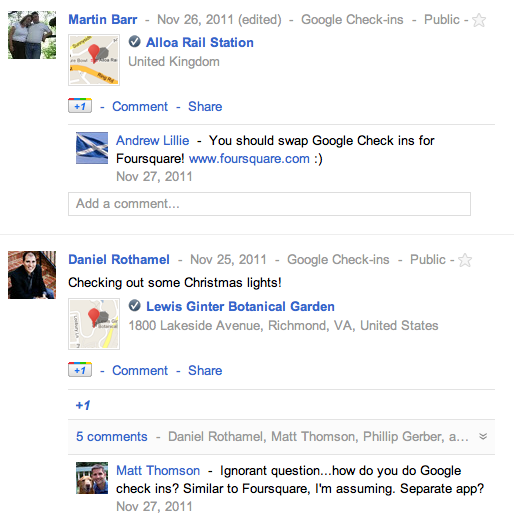
Google check-ins have a confusing history, it has to be said.

To be clear, the ability to check in via Google+ is not new.

Google’s location-based social service Google Latitude launched checkins in February, prior to the launch of Google+. And when Google+ arrived on mobile, it offered a check-in feature of its own, seemingly based on Latitude, which pulls up a list of nearby Google Places.

Google Latitude also allows you to sync your Latitude check-ins with Google+, as Google explains here. Other documentation refers to check-in offers for Latitude users (link), but again, nothing that specifically says these offers will show up for users checking in on Google+.

Whew!

Yeah, it’s kind of a big ol’ mess right now.

Google probably should have killed off Latitude when Google+ launched to avoid this kind of confusion. Maybe it still will. After all, now you can checkin on Google+ and there are so many other places to find Google’s Offers, including the Google Shopper application (iOS/Android), the Google Offers application for Android, and the Google Offers website.

And soon, apparently, Google+.

The new help documentation was spotted by Mike Blumental, who also notes that Google has recently started cracking down on businesses whose offers don’t include a real discount of some sort. Business owners are receiving emails explaining that offers should provide “a monetary discount or an additional good or service that is not normally included.” (That’s per the Offers Guidelines here.)

As for the forthcoming Google+ check-in offers, here’s the Help Documentation that explains how Google+ users can receive the deal or discount. It reads (emphasis mine):

If your customers have to visit your locations in order to do business with you, you can request that they check-in on Google+ in order to redeem your offers. They can choose to share the check-in publicly or with some of their circles, which helps spread the word about your business on Google+. They can also choose to keep their check-in private and still redeem an offer.

Again, this is not a “Google Places” check-in offer or a “Google Latitude” check-in offer being discussed here, it’s a “Google+” check-in offer.

So is this new? It appears so, because the option for a business owner to actually include the Google+ check-in offer hasn’t yet gone live within the Offers tab of Google Places, which is here such things are maintained. This is what it looks like now (see below):

This all seems to imply that Google+ is going to soon encourage more check-ins through the integration of check-in deals and discounts, similar to Foursquare. It’s an obvious next move, of course, but it’s good to see it all confirmed in black & white…help documentation.

UPDATE: It appears Google has taken down the Help page referenced in this article.

Prior to removal, the page also included the following text (thanks Bing cache!):

If your customers do not have to visit your location, for example if you serve homes or businesses by delivery or by callouts, you can keep this option off (set to “No”) and customers will not be asked to check-in when they redeem offers. We use the Service Areas and Location Settings setting on your listing to determine if you have a service area for offers that have already been created. When you create new offers, you can choose whether to allow a check-in during redemption.

What is a check-in?

A check-in is a way that a customer can chose to note that they are at a specific place. Some people share check-ins to tell friends about businesses that they visit. Some people check-in privately (instead of sharing this information with friends) so they can track businesses they have visited.

How can check-ins help my business?

Check-ins are a good way to promote your business online. It’s like an online tool for word of mouth advertising. It also associates the use of an offer with your physical location which helps connect customers both online and offline.

Will other people see my customers’ check-ins to my business?

Your customers will choose who see their check-ins. If check-ins are public, anyone can see them. If check-ins are shared with a circle, a smaller group such as the family or coworkers will see them. If check-ins are private, only the customer can see them.

If I require a check-in to redeem an offer, do people have to check-in?

Customers who use Google products that support offers and check-ins will be required to check-in when they redeem an offer. However, if they use a product that does not support check-ins (such as printing out an offer from their desktop using Google Maps), they will not be asked to check-in.

What kinds of businesses should allow check-ins when redeeming?

If customers must come into your place of business to do business with you, particularly to pay for goods and services, you should allow check-ins. This includes most businesses like:

Restaurants
Cafes
Shops
Gyms

If customers do not need to come in, even if it is only in some circumstances, you should not request a check-in. This includes offers for:

Delivery businesses like pizza delivery or office supply delivery
Services like plumbers, roofers, and carpet cleaners
Businesses where orders can be placed and paid via phone or internet, such as a florist


Product:Google+
CompanyGoogle

A Google project headed by Vic Gundotra and Bradley Horowitz, Google+ is designed to be the social extension of Google. Its features focus on making online sharing easy for users. “Circles,” think social circles, akin to Facebook’s lists “Sandbar,” a user-unifying toolbar “Sparks,” a search engine for sharing content between users “Messenger,” a group messaging app that allows users to share with certain “Circles” “Hangouts,” group video chatting designed to allow up to 10 users video chat at once Each Google+ user can replace his...

LEARN MORE

Facebook Timeline Rollout Starts Today, First In New Zealand


screen-shot-2011-09-22-at-11-00-09-am

Facebook has announced that it will begin rollout of Timeline, starting with New Zealand. If successful there it will release the profile redesign elsewhere. The country was likely picked because it speaks English, which eases feedback processing, and isn’t as interconnected with the rest of the user base as some other countries. It’s been 2.5 months since Facebook unveiled the Timeline profile redesign at f8 and said the rollout would begin shortly. However, possibly due to product tweaks and a lawsuit from Timelines.com, until today the feature was only available to developers, or those who pose as them.

Facebook will have to explain the privacy ramifications of Timeline very carefully. By making the entire history of a user’s Facebook activity more readily accessible, embarrassing or objectionable content could be surfaced if users don’t know to curate their Timelines properly. → Read More